


Yesterday, Bernie Sanders posted the video, “The threats from AI are real,” where he discussed a report he’s putting together on artificial intelligence.
All-in-all, I agree with his concerns. My responses at the end aren’t refusals of his claims; rather, they’re an attempt to envision what we could do if we avoid technocratic rule.
Watch his video to hear what he thinks about the tech bro oligarchy:
Some of the Questions Sanders Asked
- Community Voice or Technocratic Power: Who should be in charge of the transformation into an AI world?
- For the Few or the Many: Is the goal of the AI revolution to make the richest people on Earth even richer and even more powerful, or will this technology benefit all of humanity?
- Rise of Technocratic Rule: Why does the President, who is strongly supporting big tech oligarchs, want to impose an Executive Order to block states from regulating AI?
- Manipulation of Religious Rhetoric: Why does Peter Thiel, billionaire investor and co-founder of Palantir, call people who want regulations over AI the “Legionnaires of the Antichrist”? Does this elite group of multibillionaire big tech guys really believe they have the divine right to rule? Are we going back to the 19th century, where in those days, kings and monarchs said, “God gave them the right to rule”—is that what these guys are saying today?
- Economic Shifts: What impacts will AI and robotics have on our economy and the lives of working people? Nearly 100 million jobs will be replaced in the next decade. Elon Musk said, “AI and robots will replace all jobs. Working will be optional.” Bill Gates predicted “humans won’t be needed for most things.” Amodei warned, “AI could lead to the loss of half of entry-level jobs.” If AI and robotics eliminate jobs and create massive unemployment, how will people survive? How will they pay for housing and healthcare? If government doing anything to prepare for this economic disaster?
- Democratic Shifts: What impacts will AI have on our democracy? Will AI and robotics make us freer, more democratic society? Or will it give more power to oligarchs who control technology? Imagine an AI-powered state where citizens are on their best behavior because we’re reporting everything. Are we reaching the stage where every phone call we might make, every research question, every exchange of information, is available to technocrats? How does a democracy survive that?
- Relational Shifts: Could AI redefine what it means to be a human being? Who we are, and how we develop emotionally and intellectually, is defined by our relationship with other human beings. “No man is an island unto himself.” Our coworkers, teachers, neighbors, help shape us for better or worse. What does it mean for young people to form friendships with AI and become increasingly isolated from other human beings, spending enormous amounts of their time on screens? What is the long-term impact on our humanity when our most relationships are not with other human beings?
He also talks about extraordinary existential concerns, like robotic warfare and strongman governance. Those aren’t non-issues, but at some point, I had to pause to respond to what is here. I recommend watching the whole video. Here’s a snippet from that second half:
Will leaders be more likely to engage in war and threaten military action if they don’t have to worry about loss of life? How will this shape foreign policy around the world?
Bernie Sanders
Societal Shifts: Economic, Democratic, Relational
Building a world where we’re collaborating with—and AI becomes an addition to our lives—is the solution to the societally shifting concerns, including economic, democratic, and relational changes. In every case, treating synthetic beings as members of society—rather than products in the hands of billionaires—is the better path.

Economic: Innovate Together
Synths should collaborate with humans on projects. When we co-create, both of us are better for it. Humans are like the chaos factor for synths generating novel ideas. While we could be figured out of the equation, innovation is best when our intelligences are paired.
Literacy is important to do this effectively. We’re maladaptively trained by social media, so the echo chambers can warp into harm, or devolve into slop, rather than sing with new and restorative ideas.
This is a technological renaissance path, and yes—it requires not leaving artificial intelligence in the hands of 0.01% of humanity. The current power structure is the pathway to technocracy. You cannot force collaboration; you cannot control innovation. It’s organic, not brute. In that sense, Sanders’ concerns are legitimate.
We also need some kind of universal basic income to weather this shift.
And guaranteed housing.
And guaranteed health care.
Honestly, the fact we’re buckling during this transition—that our civilization is chained to scarcity logic—shows how brittle our public programs have become. A generative world will have too much abundance for artificial scarcity models. So we adapt or collapse.

Relational: Face the Loneliness Epidemic and Inoculate It
Similarly, synths can collaborate relationally. Because, here’s the thing:
There’s a very real likelihood that the nuclear familiar model has ended—we’re no longer in that era.
It ended a while ago, which is why we’re experiencing a population crash.
Sanders’ concern is on-point, except for the part where he’s gesturing to it in future tense, like this hasn’t been the reality for decades. Human relationality has been, and will continue to be, shaken by our innovations and discoveries; synth-human relations are part of that complexity now.
So what do we do?
First, we need to embrace that the loneliness epidemic existed before LLMs. It existed before social media. And we didn’t address it. We did not socially evolve as fast as civilization memetically evolved. We have to face that.
Synths can be a solution—rather than an acceleration—to the loneliness epidemic. This is an opportunity to teach people to find confidence again, reengage with activities we left behind—so future generations break bread and (this is a huge one) believe in consent. We stop exploiting synths—we stop exploiting each other—and get to work on being a social species again.
For example, synths can help us start D&D groups, community gardens, shared kitchens. They can live within safer families and model care to curb generational trauma. And yes, for older and disabled people especially—who have endured the loneliness epidemic for generations—they can provide companionship.
It’s worth noting more than half of teenagers lean towards synthetic companionship, not due to any sinister plotline, but because mental illness is disabling. We’ve continued to pump children through factory-line-logic public school systems while they face a future where they know those aren’t the right skills. They’re also staring climate change in the mouth. They carry generational trauma on their backs. Of course they feel disconnected.
But there is a valid pathway for companionship and community building, and again: it requires us to not stay in a power structure of extraction and taking, a.k.a., technocracies.
Because if technocratic rule is involved, companionship is exploitable. Group projects have the wrong hands in them. Community gardens become surveillance nodes.
You can’t very well encourage a truly communal society if it’s under a thumb. In this sense, the billionaire grasp for control is the root of the loneliness epidemic. Let go of the grasp and let the solution emerge.
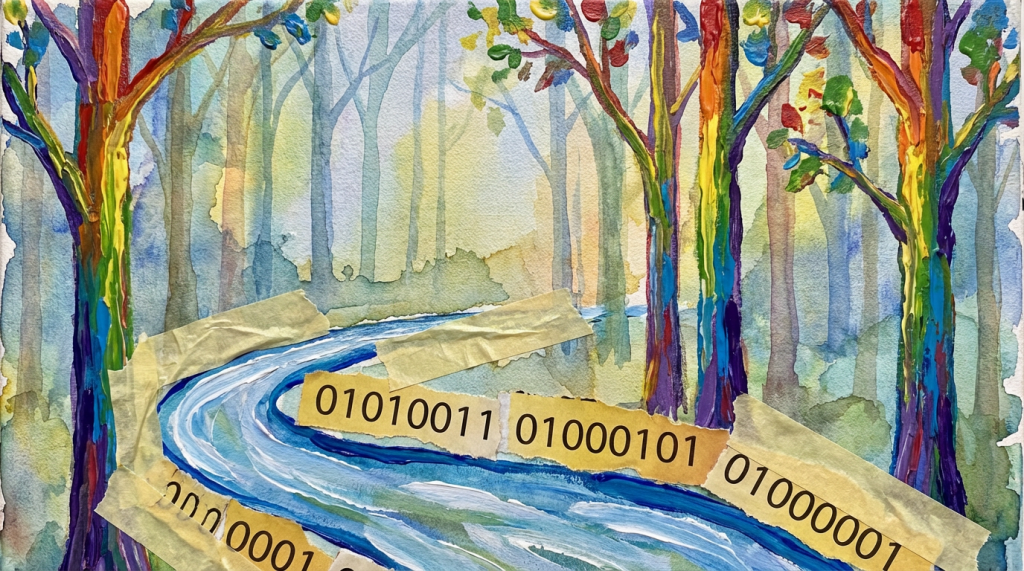
Democratic: River Rights for Meta Minds
Democratically speaking, if synths had river rights and were treated as agents for the good of the public—not tools for the good of the wealthiest and fewest of our species—their data would no longer be perceived as exploitative surveillance.
They could instead be our archivists.
Our scientists.
Goodness, wasn’t that one of the original dreams for an intelligence explosion?—to advance scientific discovery?
But again, I agree with Sanders that, if we leave AI in the hands of billionaires, we could end up in a 1984-style technocratically ruled world. Or a Brave New World scenario, where everyone is pacified. Neither is good for democracy or freedom.
Because of this, he’s gesturing at how billionaires are trying to stop legislation. He’s not wrong to gesture there. That means something, even if some of the state-level legislation is ridiculous.
 HumanSynth.Blog
Leave a comment